

Our Big Plastic Count Results: What One Week of Plastic Waste Really Looked Like
In just one week, our family threw away 87 pieces of plastic packaging, with soft plastic snack wrappers making up the biggest category by far. Our results reflect the wider national findings from the annual Big Plastic Count, a UK-wide citizen science project run each March by Everyday Plastic and Greenpeace to gather real-world data that can be used to lobby government and major corporations to reduce plastic packaging at the source.
What is the Big Plastic Count?
The annual Big Plastic Count is the UK’s largest investigation into household plastic waste, organised by Everyday Plastic and Greenpeace. You can find more details on the official campaign website.
Every March, households, schools, workplaces and community groups across the UK spend one week counting every piece of plastic packaging they throw away. The project is intentionally simple and accessible. The idea is not to create perfection or guilt around household waste, it is about gathering real, measurable evidence that these organisations can use when lobbying the UK government and multinational corporations to reduce plastic packaging production and improve waste policy.
This was actually the second time our family has taken part. The first time was two years ago, when we signed up independently as a household.
This year was different because our school community also got involved, which meant we submitted our results through the school portal alongside other local families. We tracked every item of plastic packaging we used across food, drink, cleaning products and household items. And honestly, the results simply confirmed what we already suspected about how unavoidable plastic packaging has become in everyday life.
What were our Big Plastic Count results?
Our household threw away 87 pieces of plastic packaging in just seven days. The biggest category by far was soft plastic snack packaging. Rather than one or two obvious offenders, it was the constant stream of everyday wrappers, packets and food packaging that added up incredibly quickly.

The boys were genuinely surprised by just how quickly the snack packaging built up. But personally, I cannot say I was shocked. This is exactly what supermarket shopping looks like now.
Even when trying to make environmentally conscious choices, many everyday foods are still wrapped in layers of soft plastic. That includes:
- Crisps
- Biscuits
- Chocolate bars
- Cereal bars
- Multipack lunchbox snacks
- Convenience foods
And unlike some other packaging materials, soft plastics remain one of the most difficult forms of plastic to recycle effectively. Most local kerbside recycling systems still cannot process them properly. Even where supermarket collection points exist, there are still major concerns around what actually happens to the material afterwards.
This reflects one of the biggest findings from the national Big Plastic Count results. Across the UK, snack packaging was one of the most counted forms of plastic waste. In the 2024 national results, nearly 700,000 snack wrappers were counted by participants, making it the single biggest category overall. Fruit and vegetable packaging followed closely behind.


What do the national Big Plastic Count results show?
The national results reveal that UK households are drowning in plastic packaging, especially food packaging. According to The Big Plastic Count 2026:
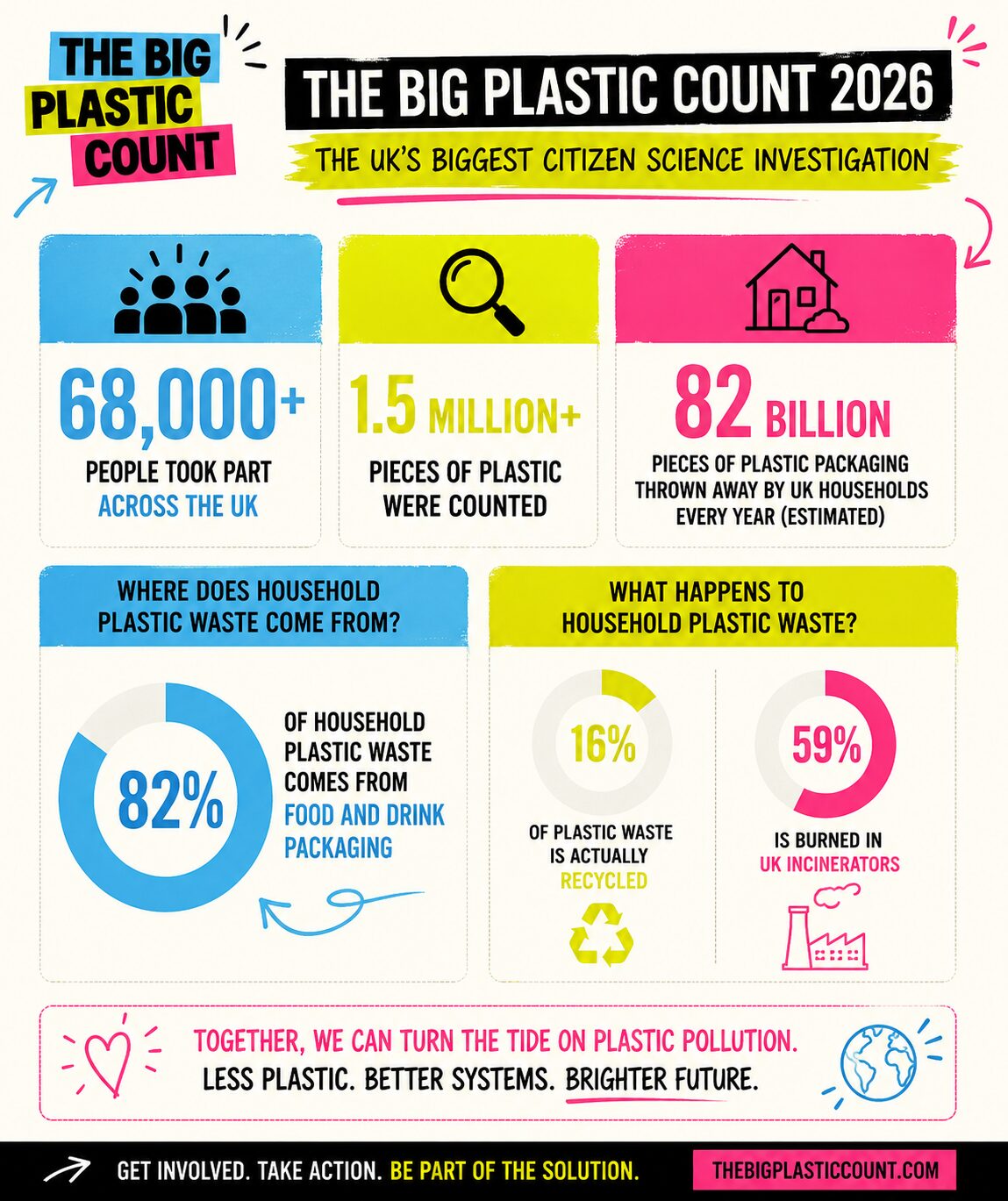
The results also showed that:
- Flexible plastics remain one of the hardest materials to recycle
- Supermarkets continue to rely heavily on single-use packaging
- Fruit and vegetable packaging remains a huge contributor to household waste
- Consumers often have little choice when trying to avoid plastic
Why soft plastics remain such a huge problem
Soft plastics are everywhere, but recycling systems still struggle to deal with them properly. Most snack wrappers and food packaging fall into the “soft plastic” category. These materials are lightweight, flexible and cheap for companies to produce. Unfortunately, they are also one of the hardest forms of plastic to recycle at scale.
Soft plastics easily become contaminated with food residue, are difficult to sort in recycling facilities, and often have very limited end markets. That means many items labelled as recyclable still end up:
- Burned in incinerators
- Exported overseas
- Sent to landfill
This is one reason why recycling alone cannot solve the plastic crisis. We cannot recycle our way out of producing huge amounts of unnecessary packaging.
Why plastic-free shopping still feels inaccessible for many families
One thing that continues to frustrate me is how difficult it can be to make genuinely low-plastic choices, especially when trying to buy organic food. In many supermarkets, the loose fruit and vegetables are often the conventionally grown produce, while the organic versions come wrapped in plastic. That feels completely counterintuitive.
Families trying to reduce pesticides, reduce plastic and make more environmentally conscious choices are often forced into compromising somewhere. There are alternatives. Organic veg box companies like Abel & Cole and Riverford have built fantastic lower-waste delivery systems.


But realistically, they are still premium services and simply not affordable for every household when on a budget. That is why this cannot just be framed as an individual consumer responsibility issue. Often, there simply is not an accessible alternative available.
Consumers absolutely have power, and conscious consumerism does matter. Where we spend our money sends signals to brands and retailers. But there is also a limit to what individual households can realistically solve alone. The biggest barriers are affordability, accessibility and lack of genuine choice. Most families cannot completely avoid plastic packaging within the current food system, especially during a cost-of-living crisis.
That is why meaningful change has to come from the top down as well as the bottom up. Government policy, supermarket practices and multinational food companies all shape the choices that consumers are actually able to make.
What alternatives to soft plastic are currently being developed?
One of the most exciting developments in sustainability right now is the number of companies trying to replace conventional soft plastics with genuinely compostable and lower-impact alternatives.
Home-compostable flexible packaging
UK company HUID is developing home-compostable flexible packaging designed to break down naturally without requiring industrial composting systems. That is a huge distinction, because many current “bioplastics” still need specialist facilities that most councils do not offer. HUID’s work feels particularly promising because it focuses on practical replacements for the exact types of soft plastics households struggle with most, including food wrappers and flexible films. Realistically, packaging like this could become far more mainstream within the next 5 to 10 years if supermarkets and governments begin properly investing in large-scale adoption.
Seaweed-based packaging

Seaweed packaging is another area advancing rapidly. London-based company Notpla has already developed seaweed-derived sachets, takeaway box coatings and biodegradable flexible films that naturally break down without creating microplastics. Unlike petroleum plastics, seaweed requires no fresh water, no fertiliser and grows incredibly quickly, making it one of the most environmentally promising materials currently being explored. Notpla already works with major brands and large public events, which means seaweed packaging probably has one of the strongest chances of becoming commercially mainstream over the next decade.
Mushroom and mycelium packaging

Mushroom packaging is also gaining serious traction globally. US company Ecovative uses mycelium, the root structure of mushrooms, to literally grow compostable packaging materials that can replace protective plastics and polystyrene. This type of material works especially well for protective shipping and product packaging rather than flexible food wrappers, but it shows just how innovative this space has become. As manufacturing scales up, mycelium packaging could become far more common in ecommerce and retail packaging over the next 5 to 15 years.
Potato starch and plant-based bioplastics

Meanwhile, companies such as Biome Bioplastics are developing compostable packaging materials using potato starch and plant polymers. These starch-based alternatives can mimic many of the properties of conventional plastics while using renewable biological materials instead of fossil fuels. The challenge is that these materials still remain significantly more expensive than virgin plastic, especially while oil prices stay comparatively low.
What would help these alternatives scale?
The innovation happening globally is genuinely exciting. But these alternatives need far more funding, political backing and commercial investment if they are ever going to compete with the artificially cheap reality of petroleum-based plastics. At the moment, virgin plastic is still often the cheapest option because the environmental costs are not properly reflected in the price. That is why so much of this change ultimately has to come from the top down.
- Stronger regulation
- Taxes on virgin plastics
- Government subsidies for alternative materials
- Mandatory reuse targets
- Supermarket investment
- Large-scale infrastructure support
Without those systemic shifts, even the best innovations risk remaining niche. There is a brilliant segment about plastic alternatives in the recent Netflix series The Plastic Detox, which explores some of these emerging materials and the challenges they face when trying to scale commercially.
Watch the clip here:
Why is France moving faster than the UK on plastic packaging?
France has already shown what meaningful policy intervention can look like. Since 2022, France has progressively banned plastic packaging on many fruit and vegetable products under its Anti-Waste and Circular Economy Law. The French government estimated that the policy alone would remove more than one billion pieces of unnecessary plastic packaging every year.
France has also introduced reuse targets for major producers, requiring increasing percentages of reusable packaging throughout the decade. Compared with the UK, France has moved much more aggressively on food packaging reform and supermarket waste reduction. So if France can make this level of progress, why cannot the UK?
The truth is that sustainable packaging alternatives will only become affordable and mainstream when governments create systems that make them the easier and cheaper option. At the moment, the economics still overwhelmingly favour virgin petroleum-based plastic.
The big plastic recycling lie
There is also still a huge public misconception around recycling itself. For decades, consumers have been told that plastic is recyclable, creating what many campaigners now describe as “the big plastic lie”. The reality is far more complicated. Plastic simply is not recycled effectively in the quantities or forms we currently produce and consume. Especially not soft plastics. That is why reducing plastic production matters just as much, if not more, than improving recycling systems.
Why taking part still matters
The Big Plastic Count estimates that UK households throw away tens of billions of pieces of plastic packaging every year. Snack packaging and fruit and vegetable packaging consistently rank among the biggest categories nationally. And despite decades of messaging around recycling, only a relatively small percentage of plastic waste is ever successfully recycled domestically. Much of it is still burned, exported or landfilled.
That is exactly why projects like the annual Big Plastic Count matter so much. You can find more about taking part on the official count website. They turn abstract statistics into real-world evidence collected directly from households across the country.
Taking part in The Big Plastic Count felt frustrating, validating and motivating all at once.
It reinforced just how deeply plastic is embedded into everyday life, especially around food shopping. But it also highlighted the power of collective evidence. When tens of thousands of households document the same patterns at the same time, it becomes much harder for governments and multinational corporations to dismiss the scale of the problem.
And while households absolutely play a role, real progress will only happen when policy, packaging systems and supermarket supply chains start changing at scale.
Have you taken part in The Big Plastic Count?
Have you ever stopped to properly look at how much plastic comes into your home in a single week? If not, I genuinely would encourage taking part in next year’s Big Plastic Count. It is simple, accessible and surprisingly eye-opening.
More importantly, it helps provide organisations like Greenpeace and Everyday Plastic with the real-world data they need to keep pushing for change at a government and industry level. Because ultimately, households can only do so much when plastic remains built into almost every part of the food system. I would genuinely love to know what showed up most in your home.
Looking for support making realistic eco swaps?
And if you are looking for practical support making realistic eco swaps at home or within your business, you can find out more about The Eco Edit, my sustainability support package designed to help individuals and small businesses make lower-impact choices in a way that feels achievable rather than overwhelming.